
Lesson
Risk and Reward Tradeoffs
Summary
Chasing the biggest payout often means accepting the biggest chance of losing it all. This lesson explores risk tolerance, the risk-reward relationship, and why our brains make calm investing so hard.
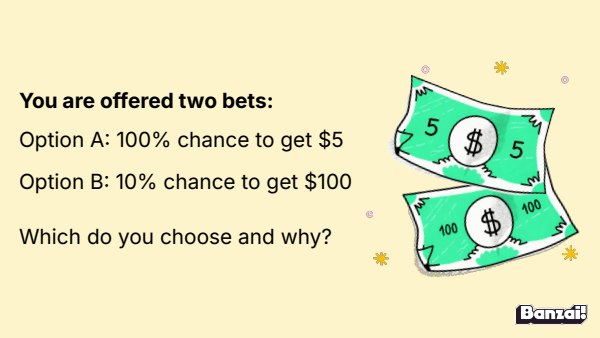
Bellringer: The $5 Sure Thing vs. The $100 Gamble
- Present the two-bet choice; give 2 minutes to decide.
- Have students share their pick and reasoning to surface personal risk tolerance.
Instruction
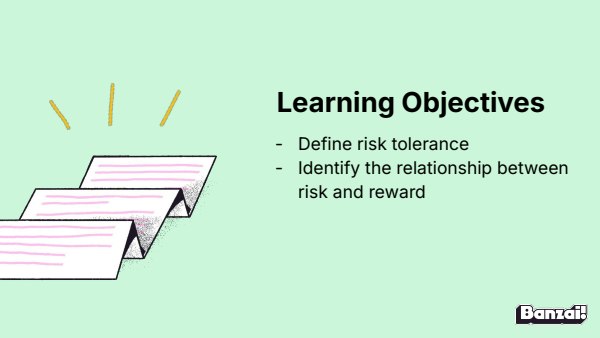
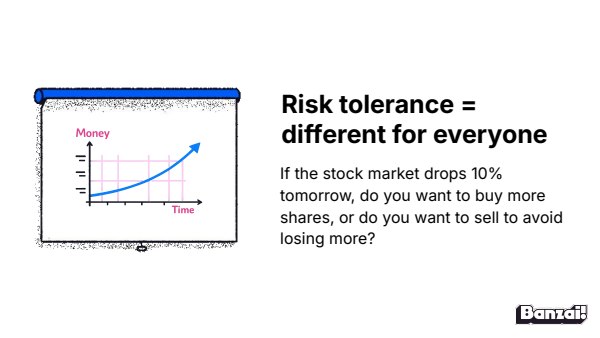
- Define risk tolerance and the three factors that shape it.
- Introduce the risk-reward relationship and three types of investment risk.
Discussion: The Brain vs. The Balance Sheet
- Vote: stronger reaction to losing $20 or finding $20?
- Connect loss aversion to real-world panic selling.
Activity: Types of Investments & Risk
- Students complete the Types of Investments & Risk worksheet, ranking investments on a risk spectrum.
Wrap-Up & Assessment
- What is risk tolerance, and why is it different for everyone?
- Why does our brain's natural loss aversion make it hard to be a calm investor?
| Est. Time | Activity | Description |
|---|---|---|
| 8 min | Bellringer: The $5 Sure Thing vs. The $100 Gamble |
|
| 10 min | Instruction |
|
| 10 min | Discussion: The Brain vs. The Balance Sheet |
|
| 12 min | Activity: Types of Investments & Risk |
|
| 5 min | Wrap-Up & Assessment |
|
Lesson Prep

Types of Investments & Risk
Complete descriptions of different investments types and determine their risk level.

Investment Types
Do you know the difference between a stock, bond, and mutual fund?
Class Presentation
Includes a 15-slide deck with teacher notes. Present from Banzai, download a PDF, or copy it to Google Slides.

Presentations, Ready to Go
- Built-in PresentationPresent full screen, straight from Banzai
- Copy to Google SlidesMake an editable copy for your class
- Download or PrintSave as a PDF or print
- Teacher NotesSlide-by-slide guidance, printable as one handout
Unit 7: Investing Money

Stocks, Bonds and Mutual Funds
Investing options fall into two general categories: lending money and owning companies. This lesson explores the core investment vehicles (stocks, bonds, mutual funds, and index funds) and the risk-reward tradeoff that ties them together.

Risk and Reward Tradeoffs
Chasing the biggest payout often means accepting the biggest chance of losing it all. This lesson explores risk tolerance, the risk-reward relationship, and why our brains make calm investing so hard.

Portfolios & Diversification
Owning one hot stock isn't investing; it's gambling with extra steps. This lesson explores diversification, mutual funds, and market cycles so students can build wealth without betting it all on a single basket.
How do Banzai lesson plans work? See the FAQ.